Skip to content
PCAT

For organizations

Does your team’s English get through at work?

PCAT checks how employees and candidates communicate across all four skills in tasks close to real work — meetings, emails, chats and a spoken role-play. Depending on the purpose, use it in place of TOEIC or another English test, or alongside it with your existing standards kept as they are. Invitations, credits and results are handled in the organization portal.

  • Four skills
  • About 45 minutes of test time
  • Results usually within 30 minutes
  • Up to 5 staff try it free
  • Invoice payment in arrears

The gap

Does an English score tell you how someone will communicate at work?

Work in English takes more than correct grammar and a large vocabulary. People need to follow the main points of a discussion, get the information that matters across, answer questions, and choose wording that suits the situation and the listener. PCAT includes these in the assessment: through tasks close to real work — meetings, emails, chats and spoken exchanges — you can see how someone uses English.

How to use it

Replace your current English test, or use PCAT alongside it?

Either works, depending on the purpose. We ask about your goals and who will take the test, and suggest which suits you.

Use it in place of your current test

Bring English assessment together in PCAT and check all four skills, including speaking and writing, in one sitting of tasks close to real work (about 45 minutes of test time in total).

Suits

  • Before and after training, or regular checks of English ability
  • When you want to see all four skills, including speaking and writing, in one sitting
  • When you want to do away with test venues and scheduling

Use it alongside your current test

Keep your current test and HR standards as they are, and check across four skills whether people can use English at work.

Suits

  • Checking candidates for overseas work or English-heavy roles
  • Adding to interviews in hiring and internal moves
  • Comparing existing scores with how people use English at work

We do not show score conversions or equivalences with other English tests. PCAT reports results as CEFR-aligned levels.

What PCAT adds

What does PCAT measure that other scores may not show?

Whether the message got through

In speaking and writing, 85% of the score is communication: whether the task was done, whether the message could be understood, whether it suited the situation and audience, how it was organized, and whether the person could rephrase or recover. Language quality makes up the other 15%.

Tasks close to real work

Reading work chat, business documents and sets of related documents; listening to meetings with three or four speakers (some with a document to refer to), calls and internal briefings; writing chat replies, emails, reports and summaries; and a spoken role-play in which you respond to what a business counterpart says.

Four skills in about 45 minutes

Listening and Reading are adaptive, and Writing tasks also get harder or easier according to your answers, which keeps the test short. It is taken online on a computer, with no test centre and no scheduling, and results usually arrive within 30 minutes.

Results you can act on

An overall CEFR-aligned level, a level for each skill, dimension-level scores with feedback for speaking and writing, and a study plan — for each person, and by department in the portal.

See a sample score report →Scoring →

Test screens

What do the test screens look like?

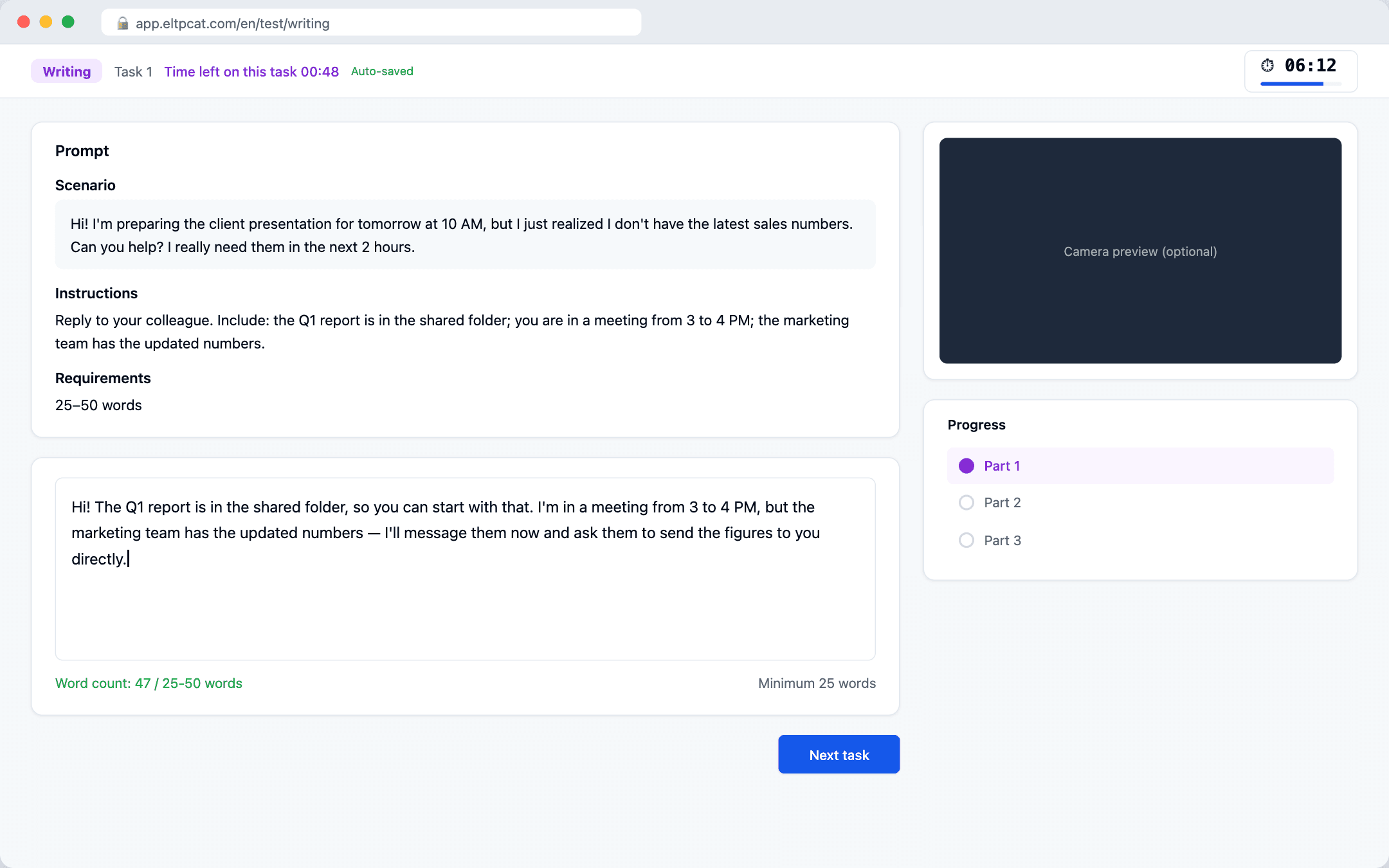
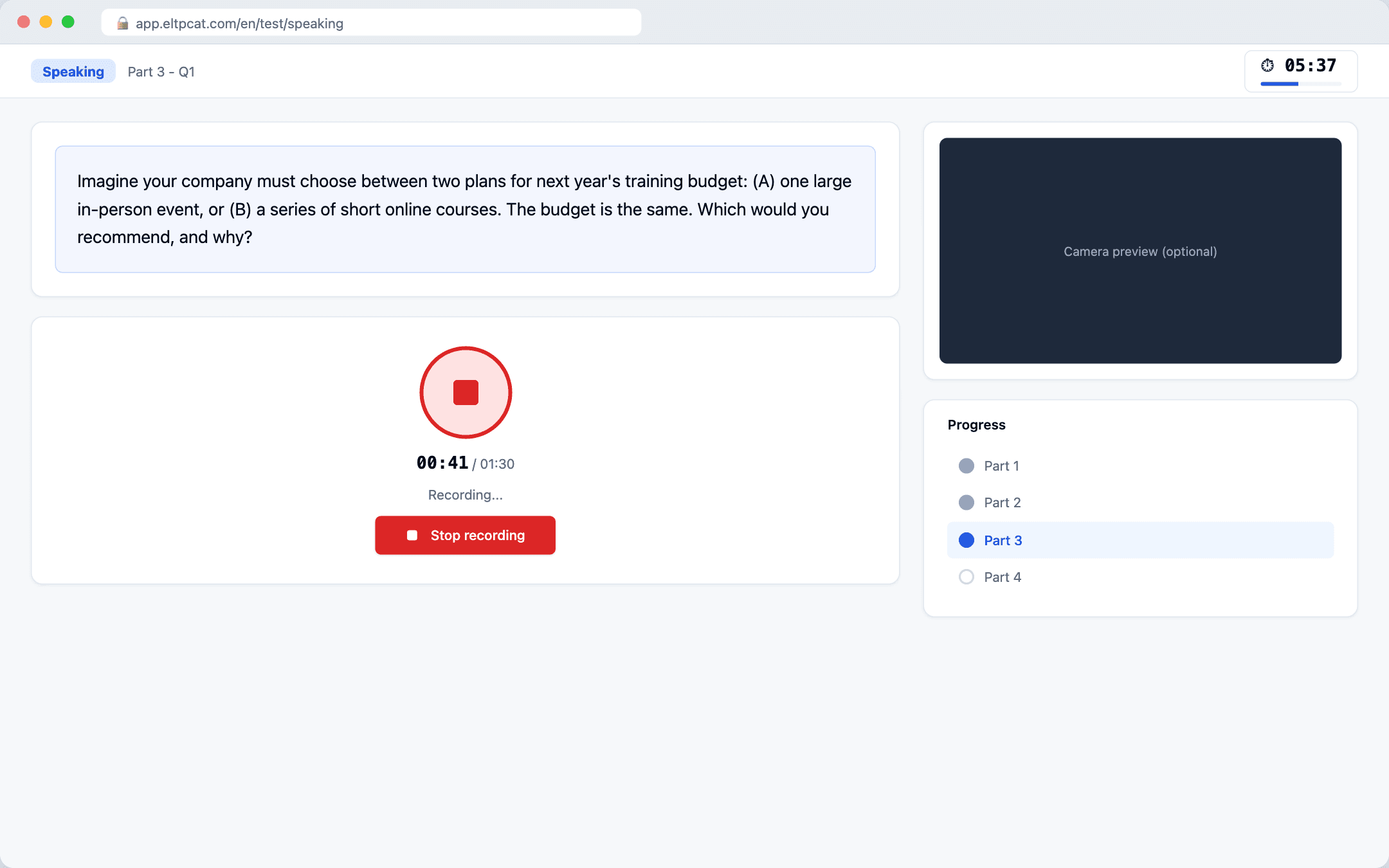
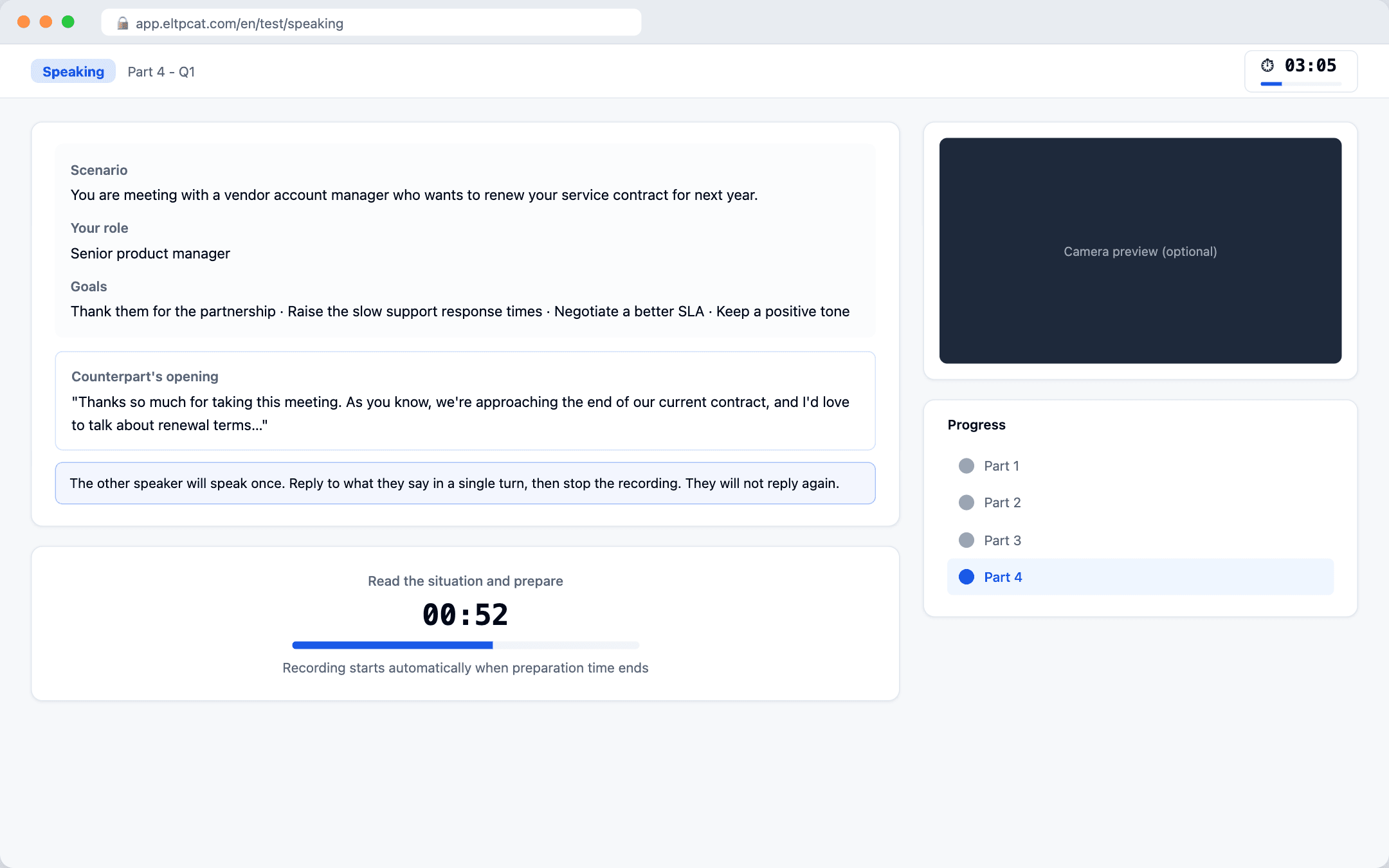
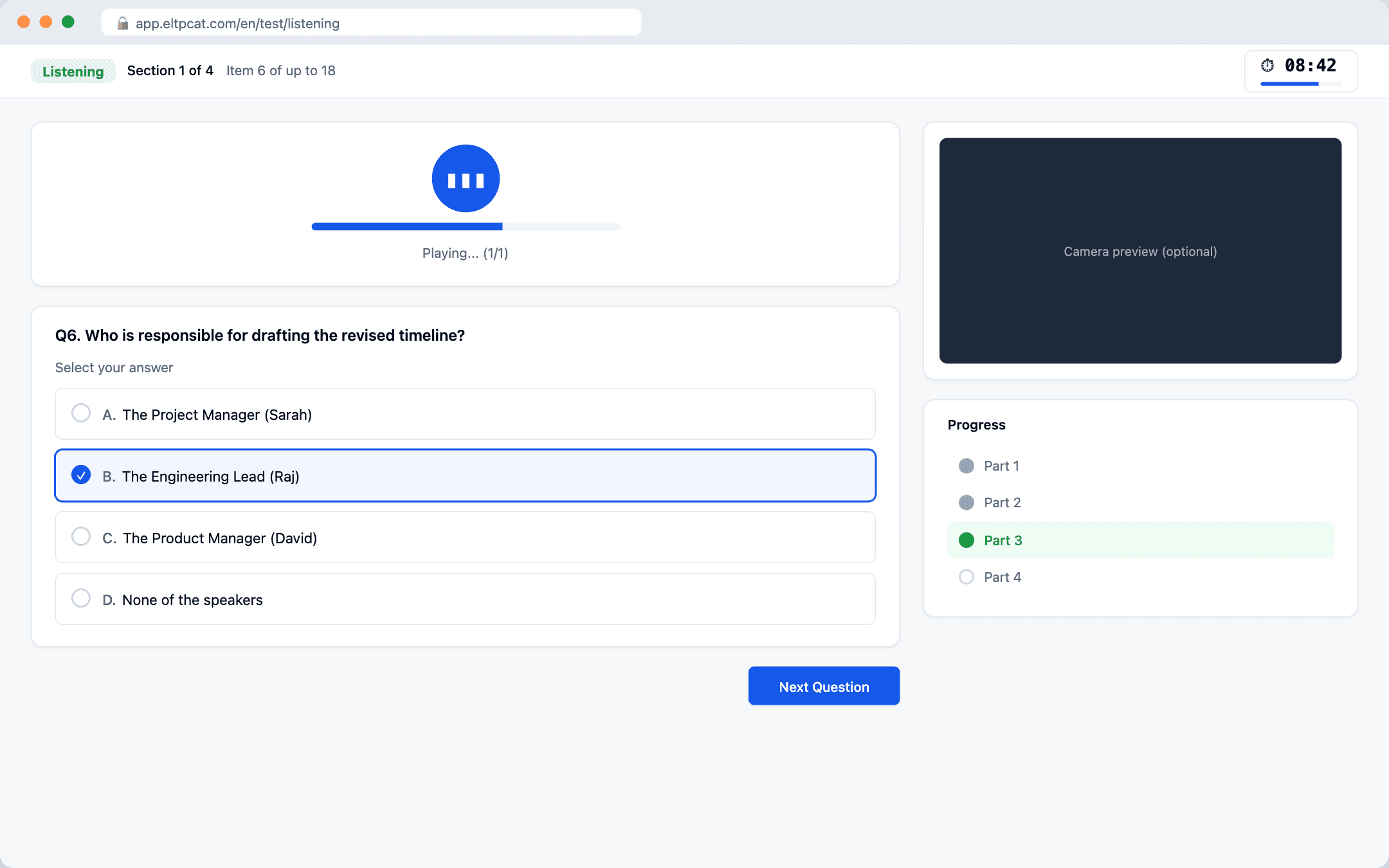
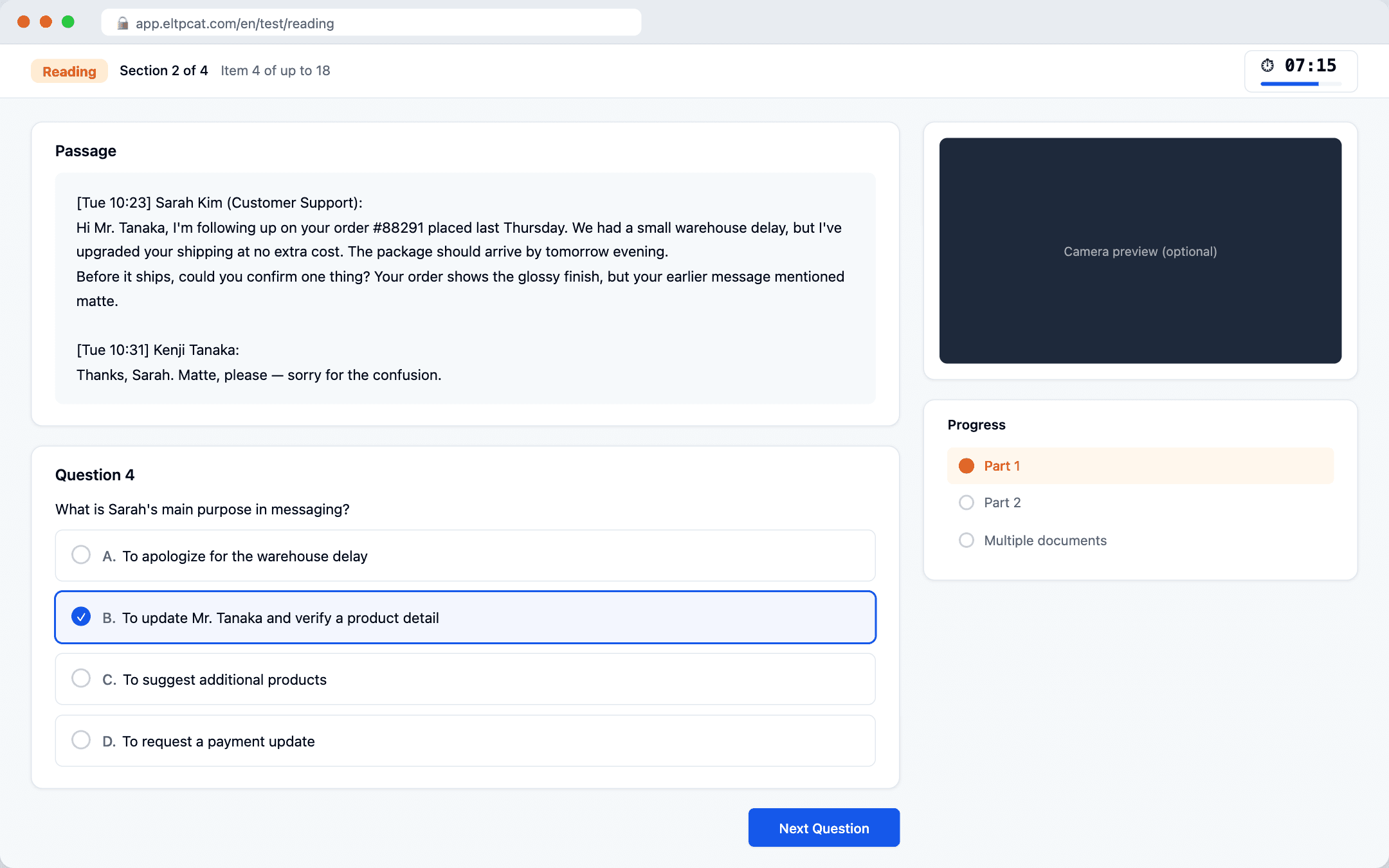
You take the test in a browser on a computer. The time left is shown at the top and your progress on the right. Using the camera is optional.

Screens are examples for illustration. Questions, answers and times differ from the real test.

Listening: hear a meeting with three or four speakers once, then choose from four options
Reading: read a work chat and choose the writer’s purpose
Writing: reply to a colleague’s chat message within a word range
Speaking: record your answer to a task asking for an opinion or recommendation
Role-play: read the situation, your role and goals, then respond aloud to what the other person says

Scoring and results

How are tests scored, and what comes back?

Listening and reading are scored automatically. Each speaking and writing response is scored three times independently by AI, and the median is used for each dimension. Results come back as CEFR-aligned levels, usually within 30 minutes.

How speaking and writing are scored

  1. 01ResponseSpeaking audio is transcribed and pronunciation is assessed.
  2. 02Scored three times by AIThe same response is scored three times independently.
  3. 03Median for each dimensionEach dimension’s 0–4 rating is the median of the three.
  4. 04Two layersCommunication 85%, language quality 15%.
  5. 05Score and feedbackA PCAT Score, a CEFR-aligned level and how to improve on each dimension.

All scoring is done by AI. The median of three independent scorings is used to reduce the variation of a single scoring.

PCAT Score and CEFR bands

The PCAT Score is not a percentage correct. It is a scale from 80 to 230 on which each CEFR band spans 20 points.

  1. Below A180–99
  2. A1100–119
  3. A2120–139
  4. B1140–159
  5. B2160–179
  6. C1180–199
  7. C2200–230

The lower half of a band is shown as .1 and the upper half as .2 (for example, B1.2 is the upper half of B1). This is PCAT’s own division, not a CEFR level as such.

Use cases

Where can organizations use PCAT?

Best fit

Before English training

Find out where each person stands in all four skills, choose who needs training and place them in the right class. The dimension-level results show what each person should work on.

Best fit

Roles that use English every day

Alongside your existing criteria, check how candidates for overseas assignments or English-heavy roles handle meetings, emails and spoken exchanges.

Good fit

Hiring and internal moves

Add a four-skills view of practical English to CVs, interviews and existing scores, as one more source of information for roles that involve English meetings, emails and calls.

Good fit

Before and after training

Take PCAT before and after a programme to see how skill and dimension results changed. Talk to us about how to set this up.

We do not recommend using PCAT as a cut-off for promotion or as the only basis for a pass/fail decision, because it is not a proctored test with identity verification. In hiring and internal moves, use it as one additional input.

Organization portal

What can administrators do in the organization portal?

Administrators sign in to the organization portal to run PCAT for their organization, from inviting test takers to reviewing results.

Test periods

Set up a test period for a group or department, with a deadline and reminders to people who have not taken the test yet.

Test takers

Register test takers one by one or in bulk from a spreadsheet, and invite them by email.

Credits

Allocate the organization’s credits to test takers. Set an allocation limit per department and see usage by department.

Results

See results and score reports for each person and CEFR distributions by department, and export them as CSV or Excel files.

Administrators and security

Give administrators Owner, Manager or Viewer roles, require two-step verification, and review the activity log.

Managed operations

We can also handle registration, invitations and resends, test periods and reminders, credit allocation, and checking and exporting results for you from our admin console. Actions we take appear in your audit log as “actions by PCAT”. Included in pilots; quoted separately for full rollout.

Organizations see scores, CEFR levels, skill-level results, score reports and a record of the test conditions. The text of answers, audio recordings and video from the test are not shared with organizations.

Data and security

How is test data handled?

Key points for IT and security reviewers. See the Privacy Policy for details.

Where data is stored
Audio, video and answers are stored in the Japan region of Microsoft Azure.
Processing outside Japan
AI scoring, speech transcription, feedback translation and learning plans are processed by AI services outside Japan (such as in the United States).
Not used for AI training
Answers, audio and video are not used to train general-purpose or foundation AI models, and are not provided to third parties for AI training.
What organizations see
Organizations see scores, CEFR levels, score reports and test-session records — not the text of answers, audio, transcripts or video.
Protecting the organization portal
Two-step verification, Owner / Manager / Viewer roles, an append-only audit log and re-authentication before export. The design prevents access to other organizations’ data.
Retention and end of contract
Audio is kept for 2 years from the test date, video for 1 year, and answers and scoring data for 5 years. Unless your contract says otherwise, we delete test-taker information received from your organization within 90 days after the contract ends.
Vulnerability assessment
We carried out an internal vulnerability assessment in October 2026.

Getting started

Can we try PCAT with a small group first?

Yes. A staff trial and a pilot let you check that PCAT fits your environment and goals before you expand.

  1. STEP 1

    Staff trial

    Up to 5 people, one test each, to see the test screens and the score report.

    Free

  2. STEP 2

    Pilot

    From 10 people, with the number and period designed around your needs. We handle registration, invitations, reminders and collating results, and hold one results briefing.

    Pilot rate: JPY 4,000 per test (excl. tax)

    Billed in arrears for tests actually taken. Pilot period only.

  3. STEP 3

    Review

    At the results briefing we explain the totals and our observations. You decide whether to continue.

    Included in the pilot

  4. STEP 4

    Full rollout

    Expand coverage year by year. As standard, your team runs the organization portal.

    Quoted for you

Examples of what a pilot checks: completion rate, how the test runs on your devices, whether results look reasonable against existing evaluations and what managers see, and the workload for staff.

For fewer than 10 people, please ask us.

Getting started

How does it work from contract to results?

  1. 01Tell us what you want to check, how many people and when. We suggest how to use PCAT and send a quote.
  2. 02After signing, we add credits to your organization. Payment is by invoice, in arrears for tests taken.
  3. 03Administrators invite test takers in the organization portal and allocate credits to them.
  4. 04Test takers sit the test on a computer (Chrome, Edge or Safari); the time limits add up to about 45 minutes. Phones and tablets are not covered by our testing.
  5. 05Results usually arrive within 30 minutes. Review and export them in the portal.

Pricing

How much does PCAT cost for organizations?

You pay a price per four-skills test, invoiced monthly in arrears for the tests actually taken. Unused tests are not charged. We quote a price after hearing about your goals and who will take the test.

  • Includes the test, AI scoring, the score report (PDF in Japanese or English), the learning plan and use of the organization portal. No registration or report fees.
  • Contracts run for one year. Managed operations and results briefings for full rollout are quoted separately.

Option

Can the test use content from our industry or role?

Option (quoted individually)

As an option, we can learn about your industry, roles and work situations and prepare test items written on those topics for you. The score scale and CEFR-aligned levels stay the same, so results remain comparable with tests taken on standard items. Your confidential information is never put into item text. We quote according to how much is customized and the number of tests, and confirm the timing with you individually.

FAQ

Questions from organizations

Can PCAT be used instead of TOEIC or other English tests?

Yes, depending on the purpose — PCAT can replace your current test or be used alongside it. Where you want to see all four skills, including speaking and writing, in one sitting — before and after training, or for regular checks of English ability — it can take the place of your current test. If TOEIC or another test is built into your HR standards, you can keep it and use PCAT as an additional way to check how people use English in practical work tasks, across all four skills. The two measure different things: a listening and reading score reflects accurate understanding, while PCAT puts whether the message got through and the task got done first. Using both gives you a fuller picture than either alone.

What results can the organization see?

For people who took the test with your organization’s credits while belonging to your organization, administrators can see the score, overall and skill-level CEFR levels, the score report and a record of the test conditions, such as whether a camera was used. The text of answers, audio recordings, transcripts and video are not shared with organizations. Access is limited by administrator role, and viewing and exporting results are recorded in the activity log.

Where and how do test takers sit the test?

Online, on a desktop or laptop computer with Chrome, Edge or Safari and a microphone. Phones and tablets are not covered by our testing. There is no test centre and no fixed date: test takers start whenever they are ready within the period you set. A camera is optional; if it is on, the session is recorded and the report notes it. If a test taker is interrupted, they can resume within 24 hours of starting the test.

Can the questions be tailored to our industry or roles?

Yes, as an option (quoted individually), we can prepare test items for your industry, roles and work situations. The score scale stays the same. We quote according to how much is customized and the number of tests, and confirm the timing with you individually.

How do we pay?

Organizations pay by invoice. We invoice monthly in arrears for the tests taken, and pricing is quoted for you. After signing, we add credits to your organization and your staff allocate them to test takers in the organization portal.

How many people do we need to try it?

Up to 5 staff can take a free trial test (one each). From 10 people, a pilot at a special rate includes managed operations and one results briefing. For fewer than 10 people, please ask us.

When do results arrive?

Usually within 30 minutes of finishing the test. At busy times it can take longer. Results can be viewed and exported in the organization portal.

Do you have materials for an information-security review?

If your approval process or security review needs them, we provide documents and answer security checklists. The key points — where data is stored, processing outside Japan and retention — are summarized in “Data and security” on this page and in the Privacy Policy.
Talk to us about your organization’s needs

Tell us what you want to assess, for how many people and when. We will suggest how to use PCAT and send a quote.